1 Game a Week – Week 8 (Ludum Dare 49)

Note: This post-mortem shows some solutions to the game’s puzzles. If you want to try figuring out these puzzle solutions yourself, please play the game before reading the rest of the post-mortem. I hope you enjoy!

Last weekend I took part in Ludum Dare 49, my first one since Ludum Dare 33 in 2015! Hard to believe it has already been 6 years since my first LD game jam. Realising how few games I’ve made in the last few years makes me wish I took part in Ludum Dare more, along with making more small games and prototypes, or doing 1 Game a Week earlier. Ah well…

I started the jam on Friday by looking at the different themes and trying to come up with ideas for each potential theme. I don’t think this is a bad idea in theory, but how I went about it wasn’t particularly helpful. I focused way too much on the theme and on trying to come up with an interesting interpretation rather than something I could execute. This meant that when the final theme was announced to be ‘Unstable’, I already had an idea for a game. Unfortunately, it wasn’t an idea I could do justice.

I spent Saturday and some of Sunday morning trying to create a game where you fly an airplane by controlling the left and right engine throttles. I wanted to make a game where controlling the plane felt unstable. In reality, you can technically fly some planes with just the throttles, but obviously it’s a lot easier (and safer) to use the control surfaces. I leaned too hard into the “simulation” feel, and the game was just dreadful to play. I had to pull the plug on it on Sunday morning and come up with a new game on the spot, I would have actually felt bad if people had to play this.

Hard Controls + Janky Physics = Bad Game

This was a risky game to make in such a short amount of time, and I’m sure it’s possible to release a good game with this idea. It’s essentially 3D Flappy Bird in a way, so a more arcady flight model could have helped. Even if I had the controls working though, I’d need to figure out the goal of the game and add polish all on Sunday. I really wasn’t enjoying myself at this point, so I scrapped the game.

There were only 10 hours left until compo submission hour, so I wasted no time making a new repo. I’m glad I made a template script earlier in the week that sets up a project skeleton and sets up a GitHub repo automatically, which saved me some time.

I wanted to make something with the simplest movement mechanics possible, so I elected to use a grid-based movement system since it’s trivial to implement. I actually got movement working and then the walls before I considered what the game was actually going to be.

Since the theme was ‘Unstable’, it made sense that there would be an unstable floor. But I think just having the floor collapse underneath you is boring by itself, so I had the idea that you need to shoot down the walls to get through the level, but doing so destabilizes the floor around it. If you walk on an unstable floor, it turns into a pit. If you walk into a pit, you need to restart the level! This took me 2 hours in total to make, since all that’s happening is I’m swapping out game objects whenever the player walks over a floor tile or a bullet hits a wall.

First Gameplay Demo

I actually thought this was fun by itself, but knocking down adjacent walls just felt like there was no strategy to it. The two other mechanics that I added are quite subtle, but I think they add depth to the gameplay.

First, I made it so if a wall collapses and there is a damaged floor tile beside it, it becomes a pit. This means that if a player just keeps on destroying adjacent walls, they won’t be able to just walk through them since the floor will have also collapsed.

The other mechanic was to make it so if you destroy a wall, the tile 2 spaces behind it is also damaged. This meant that which direction you shot the wall from would be important. The biggest problem with this game is actually explaining these mechanics, as it was difficult for a lot of players to figure this out. It could have been improved with better visual feedback and some smaller showcase and tutorial levels leading up to the bigger levels.

Level 1. Notice the extra floor tile being destroyed behind the wall.

Once these mechanics were implemented, all I had left to do was make some levels. For once, the programming was the easy part. I’m not that used to level design in general to be honest. Almost all of my games are arcadey and are set in an arena, or a ‘prototype’ level to show off the mechanics. I’ve also never made a puzzle game before, so this was all new territory for me from a game design standpoint!

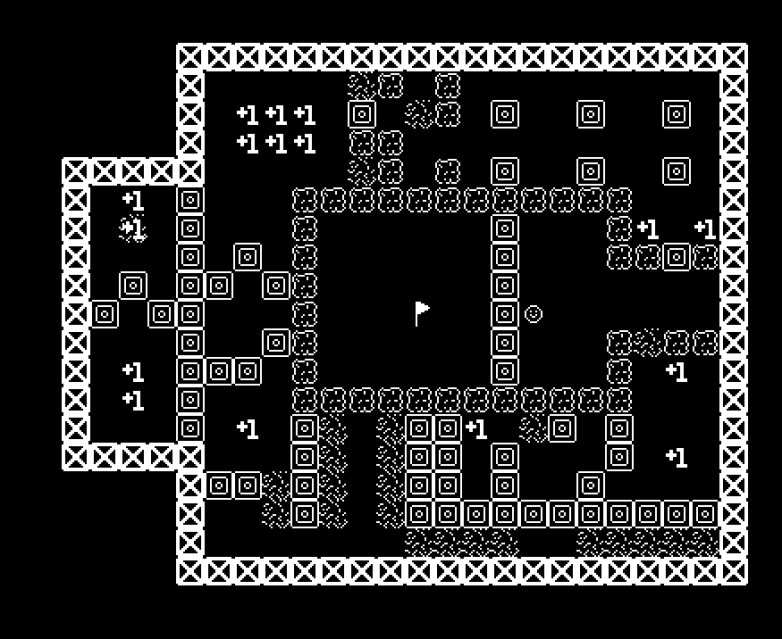
My process for making the levels was to essentially just show off the mechanics that I implemented. For example, the second level was designed to show off the adjacent block breaking mechanic, as well as the mechanic where the tile 2 blocks behind the wall breaks.

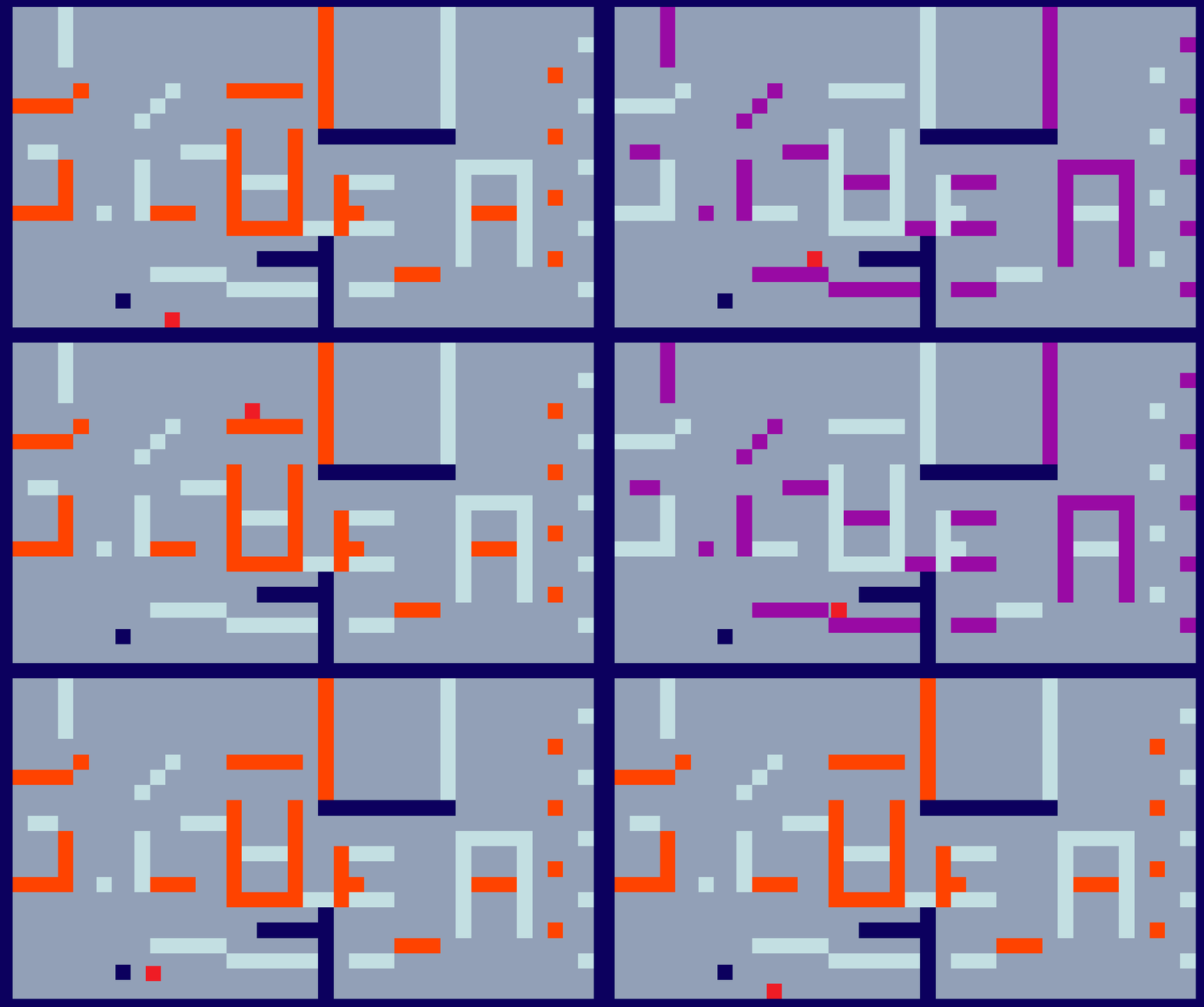
Level 2. Notice that one failed run shows that the floor tile breaks 2 tiles behind the wall. While the other failed run shows what happens if you break a tile beside you while standing on that tile.
Level 2 solution. Notice that you need to shoot the top tile from behind, so that the tile breaks towards the top of the level instead of breaking the tile beside the flag.

I originally thought this was a good level to introduce the mechanics. But when players got to this level, a lot of them got stuck. I didn’t do a good job of explaining the mechanics. I’m sorry that they dropped the game at this point, at least this was a good learning experience for me.

I focused too much on showing off two different advanced mechanics in one level, instead of breaking them into 2 easier levels before they got to this one. Some players did figure it out though, and they seemed to enjoy the rest of the game, even though Level 4 was designed to be very difficult.

Outside of the difficulty curve, other criticisms were the lack of audiovisual feedback and background music. I fully agree that this is a valid criticism, I personally think music and audio is an underrated part of a game’s design.

If I had more time, I would have definitely put in background music and better audiovisual feedback into the game. I also would have changed the sprites for the damaged floor and pit, as they’re too visually similar and noisy. I think this would have actually made it easier for the players to learn the mechanics of the game. Having a floor collapse with a distinct sound effect and animation would have added context as to what was going on, instead of just a sprite change.

What went well

  • I was able to make a game in 10 hours that people seem to like.
  • I didn’t spend too much time on up-front design. I let my intuition and the jam theme guide my design decisions.
  • The art does its job and was quick to make. 1-bit is a great art style to go with for quickly developing a game solo.
  • I was able to implement the mechanics very quickly, leaving enough time for level design.

What could have gone better

  • I should have committed to abandoning the aircraft game earlier, I had very little time to make the game.
  • The lack of Music and SFX really kills the mood.
  • The difficulty curve is too high. Players were given difficult puzzles to solve without enough information on what the mechanics were.
  • More levels and mechanics would have really elevated the experience.

What I learned

  • For prototyping, I need to iterate ideas very quickly and fail fast. The aircraft game realistically should have been abandoned super early.
  • Bad tutorials or instructions can very easily prevent players from enjoying your game. A smooth difficulty curve and pacing is crucial.
  • Simple game mechanics can actually open up a lot of gameplay depth. If I was to just make block types that break tiles in different patterns, immediately that opens up a lot of different level ideas.
  • Some players will find a better solution to a puzzle than the one you intended. A rating system in the game could be a fun way for players to compete for better solutions. Alternatively, a “developer score” would be a fun goal for players to try and beat.

Summary

Despite the rocky start, I had a good experience with the game I released this weekend, and I also got a lot of great feedback! Unlike my other games for 1 Game a Week, I have a good idea on what to improve in this game. Thanks to everyone’s feedback and kind comments, I really feel like this would be a good game if it was expanded upon. I think I’ll make a bigger version of it at some point in the near future. I really forgot how much I enjoyed the Ludum Dare experience, I won’t make the mistake of waiting 6 years to release my next Ludum Dare game.

I want to thank everyone who played and rated my game so far, it’s been great! ❤️

Bonus Image! Original Level 2 design from my notebook

As always, if you want to try out the game (and rate it!), the link is right here:
RUIN ESCAPE

“Escape from a crumbling ruin, by ruining it even more!” A game made for Ludum Dare 49

Available now to play on your browser

If you wanna play around with the code, I also have a link to the GitHub repo if you click here!

1 Game a Week – Week 7

After my satisfaction with last week’s game, I was feeling ambitious. I had a whole week to work on a game, and I was well rested from the weekend. Sitting down on Sunday, I made a rough outline of the game I wanted to make, and the tasks I’d need to do each day to make it. I even aimed to have the game complete on Thursday, giving myself Friday as an “overflow” day for any outstanding tasks. Despite all this, the game I made this week was a disappointment.

My original vision of the game had the player taking the role of a train driver delivering assorted goods to different stations in a small game world. The player would need to navigate the world by using landmarks that they would come across, with directions from the people at each train station, and with a basic paper map. I also wanted to have some humor and character interactions in the game, where the player would talk to the people loading and unloading the train at each station. The game structure would have been a bit like Cloudpunk, where the main enjoyment in the game comes from the dialogue and becoming familiar with traversing the world.

While this is definitely a large scope for 1 Game a Week, I thought it would be manageable. I’ve written dialogue before that people seemed to like in one of my first games for Ludum Dare: “This is NOT a Scam!“. Implementing the story would have been very basic. There wasn’t going to be branching paths or anything too complicated. The hard part of all this was going to be implementing the train movement mechanics. For a long time, I’ve wanted to make a “train game”, primarily because the implementation seemed like a fun programming challenge, and it’s quite different from standard grid-based or Rigidbody movement.

So with my justification for the scope out of the way, I decided to start the implementation by using Bezier Curves to define the train tracks. I’ll happily admit that Maths isn’t my strong suit, so this video by Freya Holmér helped me out a great deal with understanding how they work. I was surprised to find out that the logic behind them is quite simple, especially when using De Casteljau’s Algorithm.

After writing a very basic Bezier Curve implementation and a very crude editor script, I was able to setup a chain of train tracks. Things were running smoothly until I had to start implementing track junctions and tracks that cause the train to either reverse or run the opposite direction on the track.

So in my implementation, I’m able to get the t-value of each track segment, which is the interpolated distance between the beginning and end of the underlying bezier curve. A t-value of 0 will get the Vector2 position at the beginning of the curve, and a t-value of 1 will get the Vector2 position at the end of the curve. You can iterate over the curve, getting a Vector2 from each t-value and then using those positions to draw the curve, which is what I do here. So far, I think everything is simple enough..

Very basic Bezier Editor that I was happy with

If I’m writing a game where I need to move the player along the ground, I can add a value to the x position to move right, and subtract from x to move left. Unlike a simple 2D game where the x value can go off to infinity, each track segment has its t-values clamped between 0 and 1. I need to check for when I go above 1 or below 0 on the t-value, store the remainder, and then set my “current track segment” to either the next or previous segment. Immediately the movement logic is more complicated, and this doesn’t account for cases where you loop around the track and end up moving forward in the opposite direction, or even reversing the train.

All aboard the Non-Euclidean Express!

I don’t want to get into the entire implementation in this post-mortem, but I just wanted to demonstrate my point that the implementation wasn’t as simple as I first thought it would be. This doesn’t even take into account trying to add junctions, which also needs to take into account the “direction” of the track.

The track and direction is highlighted with red arrows. The green track is currently selected in the editor.

I struggled with this for a few days, and if I’m totally honest my motivation really dropped off on Wednesday/Thursday, when I was hoping to have movement implemented and I could start working on the world design of the game. It wasn’t until the weekend when I was able to get movement working, and that didn’t account for the train’s momentum, or taking turns too quickly, or any of the “fun” movement mechanics. I basically had a way to move around the track and change junctions. Although I did also add in some code to create the train track graphics, which was quite enjoyable.

Working movement, but junctions weren’t finished yet

The junctions took a while to finish too. This was more of a game design issue, I didn’t know the best way to show the player the current junction setting and which junction would be changed when they hit the A Button / Space Bar. I originally wanted to have the track itself change, but that would have been tricky to implement, and I don’t think it would have been easy for the player to make a judgement on the junction setting when the train is moving at speed. The best thing I could come up with was a literal sign that shows the junction setting.

Final gameplay with signs added.

At this point I had a basic prototype built and it was almost the end of the week. I knew I wouldn’t have the time or energy to create my original vision. The idea of salvaging the project and turning it into a slot car racing game crossed my mind, but at that point I wanted to just abandon this game. I put it up on Sunday, and now here I am writing the post-mortem on Monday.

What went well

What could have gone better

  • I could have cut scope earlier which would have made me less likely to procrastinate.
  • My implementations were quite buggy.

What I learned

  • I learned a lot about bezier curves and their uses. I think this will let me implement a lot of different and interesting game mechanics in the future.
  • I have some ideas on how to improve my implementation, which will be useful the next time I have to write a track system.

Summary

In the end, I don’t think this prototype ended up in a good state. In saying that, it was a good learning experience. I still like the original idea I had for the game, and this is something I’d like to pick up again for 1 Game a Month. Knowing some of the pitfalls I can run into with this game mechanic, I think a 1 Game a Month project would have a better chance of success now that I know what issues to look out for.

As always, if you want to try out the game, the link is right here:

1 Game a Week – Week 7

Prototype for a train game

Available now to play on your browser

If you wanna play around with the code, I also have a link to the GitHub repo if you click here!

1 Game a Week – Week 6

This weeks game went quite well! I was able to implement a game mechanic that I’d previously thought of as being quite complex: displaying the future positions of a physics object. In this case, I display the orbital trajectory of the spacecraft that the player is controlling. But I’m getting ahead of myself, I should start at the beginning of the week.

At the start of the week I had no idea what I was going to make. I spent some time looking through itch.io, trying to get inspiration. I decided that I wanted to make a puzzle game, and I had only watched The Matrix movies over the weekend. So I decided that I was going to make a hacker puzzle game. After a day of working on it and coming up with ideas, I had this to show for it…

GOTY????????

So, I realize I’m not having fun, I don’t really have a solid vision for the game, and I don’t actually want to make… whatever this is. It’s still early in the week, and thankfully (or unfortunately?) at this point I’ve had enough experiences like this where I know the best thing to do is scrap the prototype and make something new. No Sunk-Cost Fallacy over here.

I then decide to look through Adriel Wallick’s 1 Game a Week blog for some inspiration. Her blog and this GDC talk by her was recommended to me by Rami Ismael (@tha_rami), and is what inspired me to start making a game a week in the first place!

One game that stood out to me was her game on Week 45 (I don’t think I’ll be doing 1 Game a Week for that long!) – I liked the idea of making a space game using gravity around planets, and the trails that Adriel added to her game looked really cool. I also tried (and failed) to make a gravity based game last year, so I decided I’d give it another shot. I then thought about one of my favourite games ever: Kerbal Space Program.

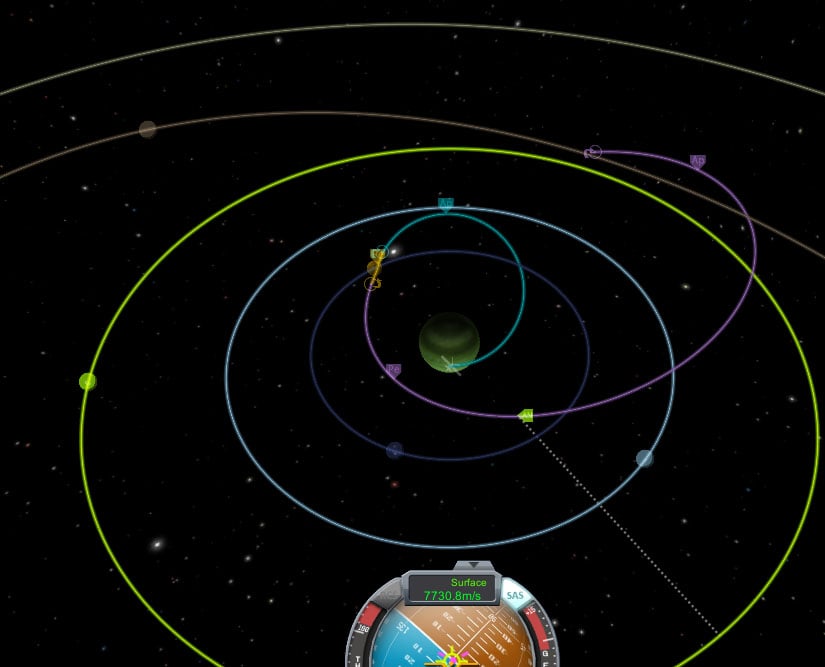
In KSP, when you are orbiting a planet you can see your future trajectory. I felt that it would be cool to make a super stripped down version of this mechanic, where you have a ship in 2D, and you need to perform orbital maneuvers to enter a specific orbit.

KSPOrbits
Orbital mechanics in KSP. Found on: studiosity.com, Source: KSP Forums

So I started making the new game in the same codebase as the last one, because I had to get the game done before the end of Friday. I first setup the code to apply gravity to objects in the scene. That was very simple to do, I just implemented the formula I found here and implemented it in code like this:

public Vector2 CalculateGravity(Vector2 otherPosition)
{
    Vector2 dir = ((Vector2)transform.position - otherPosition).normalized;

    float distanceToSurface = Vector2.Distance(transform.position, otherPosition) - m_radius;

    float gravity = m_surfaceGravity * Mathf.Pow(1 + distanceToSurface, -2);

    return dir * gravity;
}

The hard part was actually adding in the orbital prediction itself. I thought of a few ways to do it, but it turns out that you can now create separate Physics scenes in Unity. This is great, because I can create a new Physics scene, copy over the objects I want to get the trajectories from, run the simulation on the scene and then track the positions of the objects over each step. It took me about a day (and a lot of hacky code) to get it working since I’d never used this Unity feature before, but I got it working in the end! Unfortunately the code was a total mess, but it worked for the purposes of just getting this game done.

An issue with the orbit prediction feature that was a nightmare to debug

I then had the great idea of adding in an editor function where I can place objects in the scene and then see their orbital trajectory without going into Play Mode. I spent way too long on this and ran into some walls. One of which was the fact that you apparently can’t create Physics scenes in Edit Mode, which meant I had to hack together some solution to prevent existing objects from being simulated. I even asked for help on Twitter, but unfortunately nobody seemed to know the answer…

The plan was that by adding this editor feature, I’d be able to build and iterate on levels more quickly. I once again remembered my own warning with the Sunk-Cost Fallacy, and abandoned the feature. I then added in the asteroids, the bullets, and then the Delta-V and Ammunition systems. Stuck together some basic levels, and got the game finished just before midnight on Friday. I actually finished the game on Friday for once! 🥳

Gameplay of the final game!

What went well

  • I was able to finish on Friday for once! (and played Deltarune over the weekend!)
  • I made a game that I thought was fun to play, and has potential.
  • I learned how to use Unity’s Physics Scene feature to make predictions.
  • I got better at writing “quick code” to get features out for prototypes

What could have gone better

  • I could have spent way less time trying to add the unnecessary editor feature.
  • I could have had a game idea that I wanted to make ready to go on Monday.
  • I would have liked to add sound effects or music, but ran out of time.
  • I would have liked to write this post-mortem on Friday, instead of Sunday night.
  • More levels would have been nice too, but once again I ran out of time.

What I learned

  • I learned more about Unity’s physics system and how it can be leveraged to make certain game mechanics.
  • I learned how fast I can code features for a short game by cutting programming best practices. (But I still know how to use best practices for “real projects”!)
  • I learned how important it is to work on a project I’m excited about, for my motivation and ability to design the game as I go

Summary

Overall, this is my favourite game so far! I’m really happy that I was able to add the orbit trajectory mechanic as I enjoyed figuring out how to implement it, as the solution isn’t immediately obvious.

Not many people have played the game as of writing this, and I haven’t really gotten any feedback. I have some ideas on how I’d improve the game to make a full version, and if enough people like it, I’d definitely spend a few months making a full game.

As always, if you want to try out the game, the link is right here:

1 Game a Week – Week 6

Park your orbiter while avoiding space debris

Available now to play on your browser

If you wanna play around with the code, I also have a link to the GitHub repo if you click here!

1 Game a Week – Week 5

This week I returned to the familiar development environment of Unity, and so I wanted to do something a bit more ambitious with my game. Unfortunately, I didn’t get to spend as much time on the game as I would have liked over the week, and I ended up once again working on the weekend.

I didn’t quite know what I wanted to make this week, so I really just began to wing it, making whatever I thought would be cool at the time. I started by installing Shapes, which is an excellent vector-based drawing asset by Freya Holmér. I played around with it a bit, and ended up making a dog character. I really can’t overstate how great it is to be able to just make simple graphics inside of Unity instead of a workflow where you create something in an external program and import it. Obviously it wouldn’t work for larger games, but for my purposes it was perfect!

A pack of doggos

I then had to setup player input. I wanted to try adding controller support, but doing that using the normal Unity input system is a little bit inflexible. This seemed like a great opportunity to learn how to use Rewired for the first time, as I’m aware it’s used in a lot of larger Unity projects. Setup was quite simple, and I was then able to move the dog character around the screen using both keyboard and controller!

The doggo be moving

After adding the basic movement and animating the character, I realised that I needed some way for the doggo to interact with the environment. As everyone knows, dogs love to bark. I hooked up the A button and Spacebar to a bark action, added a bark sound effect, and then for extra juice, added some text that appears each time the dog barks.

I also added in some rocks and grass to the level, footsteps on the doggo, and then realised that we need something to bark at. I did a quick search for dog occupations, and came across herding dogs! It made sense that this was going to be a sheep herding game. However, I’m not a great artist, so the sheep ended up looking like rabbits. So they’re sheeprabbits, or rabbitsheep. This is canon now.

High intensity herding gameplay

At this point I was happy to have some interactivity in the game. I was thinking how cool it would be to make something kind of like Untitled Goose Game, where you can go around and bark at different people and animals, and see their different reactions. Then I remembered it was Saturday night and I need to finish the game tomorrow.

On Sunday I was really not in the mood to work on this. While I was happy with what I had made so far, there wasn’t really a game. So I made some wooden fences, set up a pen, and got to work on some glue code to get some semblance of a game structure together. Originally I was planning on making a few levels for this, but to be honest, the game just wasn’t fun once I had the first level working. I spent so much time on animating the characters and making them feel like they have a personality, but the gameplay just wasn’t there. On top of that, I couldn’t get the WebGL build to work. The game would freeze every few seconds, and there were strange visual glitches. I didn’t have the energy to fix this. So I called it a night, finished up the game and published it. It takes a minute to beat.

Gameplay of the final version

What went well

  • I was able to add personality and detail to the dog and sheeprabbit characters
  • I think movement felt good, and the game looked nice visually
  • I was able to “wing it” and make a game without planning much at the start

What could have gone better

  • I worked weekends again 😬
  • I underestimated how much time it would take to make the characters
  • I didn’t use my time as efficiently as possible. I had fun characters, but no game
  • The gameplay is a bit janky and uninteresting
  • The characters get stuck on walls a lot
  • The WebGL build didn’t work, so almost nobody is going to bother downloading this game
  • The playtime is about a minute or two, and isn’t very enjoyable

What I learned

  • I learned how to setup Rewired for keyboard and controller input
  • I learned how to use Shapes for making assets quickly in-engine
  • I learned how important it is to have the game structure working first, before adding in animations or extra details.
  • I learned to start trusting Unity’s physics system more for movement instead of trying to roll my own

Summary

Overall, this game is one that I have mixed feelings on. On one hand, I felt like it had a lot of potential. I started off with a cool character, a cool 2.5D art style and some ideas floating around in my head for what this was going to be.

Due to time constraints, overscoping and a lack of a clear design, it really fell flat from what I wanted it to be. I think if I had another week I could have made something pretty good, but that goes against the spirit of trying to make one game a week. Maybe once I start doing one game a month I can revisit this game and give it the treatment it deserved.

As always, if you want to try out the game, the link is right here:

1 Game a Week – Week 5

A short sheeprabbit herding game prototype

Available now on Windows

If you wanna play around with the code, I also have a link to the GitHub repo if you click here!

1 Game a Week – Week 4 (Stop Waiting for Godot Game Jam)

This weekend the Stop Waiting for Godot Game Jam is taking place. I was away for most of the week, so this seemed like the perfect opportunity to learn some Godot, make my 1 Game a Week game, and participate in a game jam all at the same time!

So with all of my excitement and ambition, I made a game where you eat your own shit and die.

I regret nothing

Why did I make this, when I could have made anything else? Well first, I tried to implement footsteps. When I tested them, I thought it looked like the slime was shiddin’. Then I thought it would be funny to add a fart sound. Then I realized that the game was basically designing itself. Now this game exists.

What went well

All joking aside, I actually like the game. I actually got to make a fun unique idea (although the idea of “eating” games isn’t original). It’s very simple (which is aligned with the game jam theme to “Keep it Simple”), and it’s kinda fun actually. I think if I wanted to expand the idea I’d like to add powerups like stomach medicine that stops you from shiddin’ for a few seconds. Maybe you could even pick up a bucket that lets you clean the shid from the level? There could even be a spoiled food hazard that makes you shid at twice the rate. But thankfully, I stopped at the game MVP.

What could have gone better

Honestly, a lot could have gone better. If I had a better idea I would have made it. I actually scrapped my first two ideas (a Pong clone and Sokoban clone) because I found implementing them boring, and I hadn’t quite gotten my head around Godot, so the code was a total mess.

This is a lesson I learned while making SPROUT. In a game jam, it’s sometimes worth dropping and restarting if the idea you’re making isn’t panning out. Thankfully the fart noises and the pure concept of this game entertained me, so I was able to find the motivation to finish the game this weekend. Next weekend I’m doing nothing and I’ll have my game finished for Friday 100% definitely.

Also, if I wasn’t making this game for 1 Game a Week, I actually would have given myself Monday to polish it too. But here I am, sticking to my deadlines. So the game definitely could have had more content or polish, but I’m pretty tired of working weekends.

What I learned

I learned a ton! How to make a simple game in Godot being a start, which was the point of the jam. I also feel like I’m starting to re-learn how to write code quickly to prototype mechanics. For a long time I’ve been focused on writing “good code” that takes ages to complete, but now that I’m making games in shorter time frames again I find myself getting used to the idea of making something quick and dirty.

While I’m not a huge fan of GDScript (or dynamic languages in general), I do like how I was able to setup input and movement code with very little difficulty. Also, the fact that Godot has a “move_and_slide” method that handles collisions and sliding against objects for you is absolutely fantastic. I’ll need to get something like that for Unity. I don’t want to spend a week on basic platformer mechanics again…

From a game design perspective, I also feel like I’m learning how important audio and sound is to an experience. This is carrying on from my experience with last week’s game where I played around with audio to make an underwater ambience scene. Adding a fart noise sent me down a path where I had fun and made this. So the context of the game led me down the path to developing these gameplay mechanics, instead of me coming up with the mechanics first.

Summary

I think the main thing I want to take away from this game is that I should give myself more room to make weirder projects. I should just throw shid at the wall and see what sticks. In saying that, I don’t want to make any more shid related games for the time being.

I’m looking forward to next week! I’ll take Monday off, but will give myself 4 days to make my next game. I think I’ll try to be weird with it, and will try to iterate more. I’ll also be back to Unity, so I’ll be in familiar game dev territory.

Thanks a lot for reading my post-mortem on my 1 Game a Week / Stop Waiting for Godot game!

As always, if you want to try out the game, the link is right here:

1 Game a Week – Week 4

eatin, shiddin and fardin

Available now to play on your browser

If you wanna play around with the code, I also have a link to the GitHub repo if you click here!

1 Game a Week – Week 3

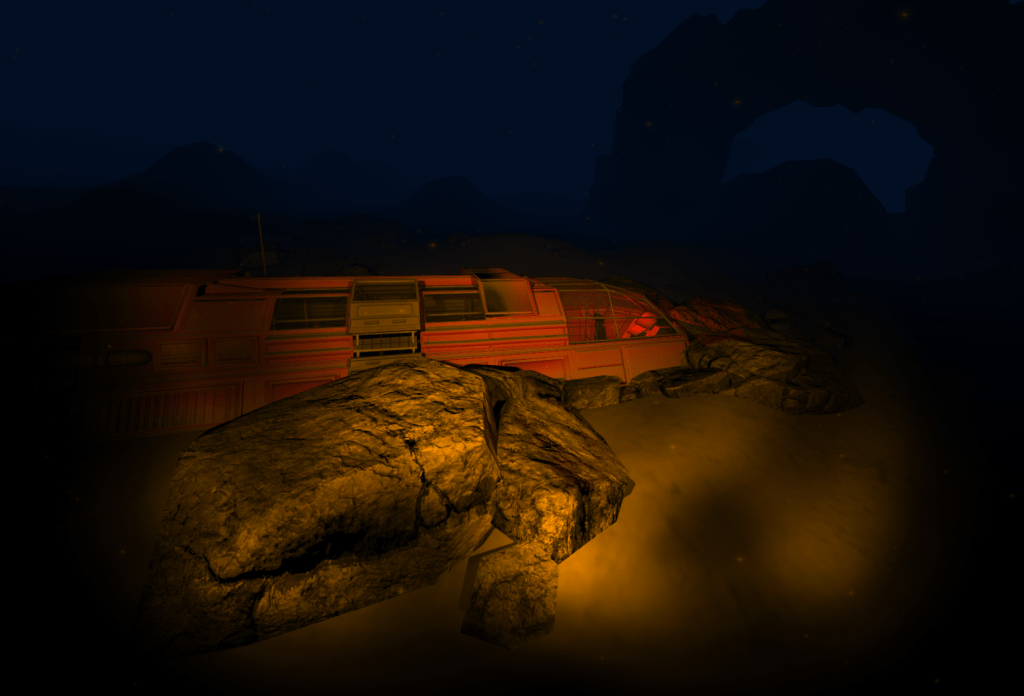
This week I might be stretching the definition of “game”. While what I made certainly has controls, there’s no real goal to the game or mechanics outside of “if you crash your submarine into terrain, you bounce back”.

So yes, this week I made a small level prototype just to play around with Unity’s lighting and fog settings, as well as just trying to get a certain feel in a level without relying on mechanics. It’s not something I do usually, but earlier in the week I was playing around with the Skyrim Creation Kit and I wanted to do something level design-y.

“Gameplay” of the prototype

What went well

I’m happy that I was able to make something that looks and sounds like an underwater environment. If I had more time and motivation I would have pushed it further. For the time I spent on this small project, I’m happy with the atmosphere it exudes.

What could have gone better

As I mentioned earlier, I spent a good few days earlier in the week doing the tutorials for the Skyrim Creation Kit to change pace from programming. When I started work again on 1GAW on Friday, I realized I once again hadn’t really taught up a game idea. This meant that I was just playing around in Unity aimlessly until I came up with something material. I then picked something I wasn’t super sure of or passionate about, and this is what I got out of it.

Also the lighting broke when I tried to make a WebGL build, so I had to resort to a Windows only build. I’m sure I could have figured it out, but I don’t think it’s worth it for a throwaway project like this.

What I learned

I learned how to write a simple 6DOF character controller with Unity’s Physics Engine. It was nice to actually have a use case to use the built in physics for a character controller. I’d like to play around with vehicle gameplay another week when I give myself more time.

I also learned how important sound design and VFX are for making a game space feel real. Mechanically, all that’s happening is I have a bunch of BoxColliders attached to a Rigidbody that moves around a space with a lot of drag. But adding in the particle effects and dark lighting really makes it feel like the character is underwater. I could probably replace the assets with space assets and not change the controls, and the player would feel like they’re flying a (very slow) shuttle.

Summary

Overall I’m happy with what I got out of my limited amount of time spent on this project. It’s definitely not a game I would recommend anyone play, but I’m now a bit more interested in learning how to make game spaces more immersive and interesting for players.

Thanks again for reading my post-mortem!

If you want to try out the game yourself on Windows, the link is right here:

1 Game a Week – Week 3

Tiny level atmosphere test prototype

Available now to download for Windows

If you wanna play around with the code, I also have a link to the GitHub repo if you click here!

1 Game a Week – Week 2

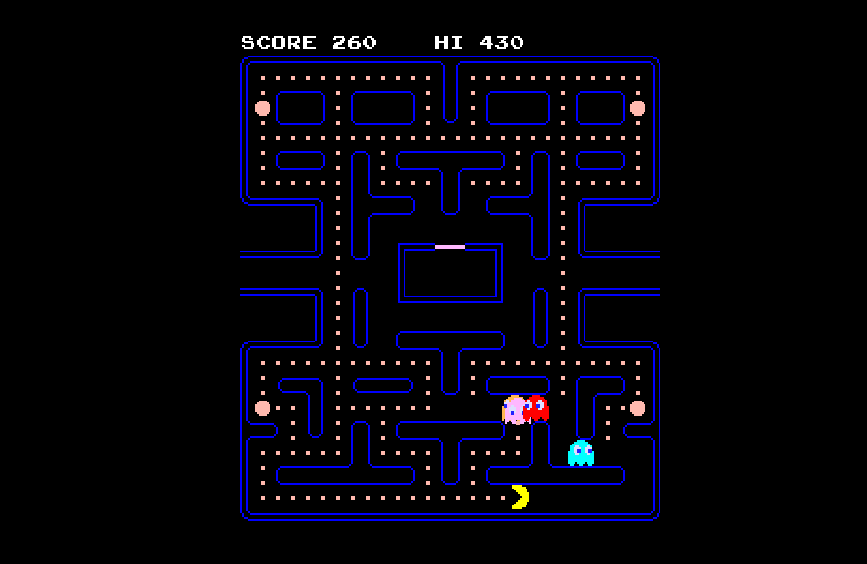
Today I finished my second game as part of 1 Game a Week! This week, I decided that I wanted to create a Pac-Man clone. The reason I did this is because I wanted to learn more about how game AI is programmed and how it fits into the design of the game. Pac-Man also works on a grid, and that meant I wouldn’t have to spend a week struggling with collision detection code.

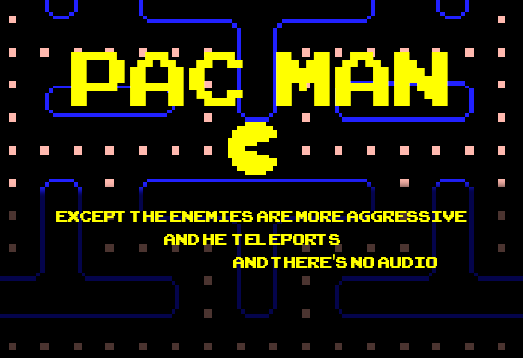
Yep, that’s Pac Man (except the enemies are more aggressive and he teleports and there’s no audio)

Just like last week, this post will be my reflections on making this game. I’ll be talking about what went well, what could have gone better, and what I learned.

Wait, you literally just made a Pac-Man clone?

Well, not quite. I like to officially call this version of the game “Pac Man except the enemies are more aggressive and he teleports and there’s no audio”. The enemies are more aggressive because unlike the original game, the enemies don’t back off and then return to attack in waves. They are always in “chase” mode.

The “Power Pellets” also function differently. Instead of giving Pac Man the ability to eat the ghosts for extra points, they teleport him to the next pellet around the board in a clockwise direction. This means that Pac Man is always running from the ghosts. The idea of turning the tables against your enemies is not present in this version, when it’s a core mechanic of the original game.

And yes, I didn’t have enough time to implement audio. Hence the title of the game.

What went well

I wanted to learn more about how a game’s AI changes the feel of the game. Playing around with the ghost AI during development was interesting, as I could see how changing the AI behavior affected gameplay. For example, adding Inky into the game gives you situations where he will try to get ahead of you and cut you off from the other side of the tunnel. Adding in Clyde will give you situations where you can play chicken against him, because you know he’ll flee to the bottom left corner once he is within 8 tiles of Pac Man. I found it fascinating that these simple AI rules gave the game a feeling of life.

https://upload.wikimedia.org/wikipedia/en/5/51/Pacman_title_na.png
The original Pac-Man character list. Image courtesy of Wikipedia (source)

What could have gone better

At the start of this week I really wasn’t feeling up to design and I wanted a quick win. I thought remaking Pac Man in 2 or 3 days would be super easy. I was wrong.

Although the game logic wasn’t that complicated, I wasted a lot of time adding in the art assets and implementing things in a non optimal way. I did things such as placing and sorting the tiles manually in the hierarchy so they would be indexed correctly in the Level class, which kept track of the coordinates of each tile. I then manually copy and pasted the pellets, or manually changed the sprites of each wall tile in the level. A lot of this was just busywork, when I could have used something like Unity’s 2D Tile Based Editor to setup the level.

The other thing that could have gone better was thinking more about design up-front, and scoping my time so I don’t work on weekends. Because my goal was to essentially remake Pac-Man, I didn’t think about design until I needed to cut features to make the game by the end of the week. In this case, I cut the wave based AI and Power Pellets. I don’t think teleporting is a great mechanic, and it was honestly just the easiest twist I could implement at that time.

As for working weekends, I find myself pretty tired after working on this game, especially considering I worked last weekend to finish my game last week. Next week, I’m planning on working on something with a tiny implementation scope, but an interesting game design.

What I learned

I had the opportunity to reacquaint myself with some Unity features. Specifically the Mecanim animation system. I also learned that sometimes it’s worth slowing down and learning a new system rather than brute forcing a solution. Specifically, learning the 2D Tile Level Editor instead of hand-placing the tiles and sorting them in the hierarchy.

While I didn’t design this game, since it was already developed by Namco in the 80’s, I did gain some design insight while developing the game. As I mentioned earlier, seeing how the gameplay changes as the different AIs are implemented gave me an appreciation for how simple AI can improve a game. Mark Brown’s video on Pac Man and gameinternals.com were both hugely beneficial resources to have while trying to replicate the AI behavior.

I also learned how important good art assets are for changing the feel of the game. I could have shipped the game with the following programmer art, but I don’t think it would have the same emotional response:

Early version of the game with a simpler art style. Still clearly Pac-Man

I think from this, I want to explore game AI a bit more. I’d also like to see if I can make my own simple art for my next game, to see if I can get a specific emotional response out of it.

Conclusion

As always, thanks so much for reading my post! The game link is available here if you want, along with the source code below.

1 Game a Week – Week 2

Pac Man except the enemies are more aggressive and he teleports and there’s no audio

Available now to play on your browser

Source code: https://github.com/Reccy/1GAW_2

1 Game a Week – Week 1

Today I finished my first game as part of 1 Game a Week! It’s not much, just a small platformer prototype, but I’m glad I got it done (especially considering the trouble I was having with one last bug). I learned about 1 Game a Week during a short consultation with Rami Ismail (@tha_rami), where he told me that it’s one of the best ways to improve one’s game programming skills. As someone who is trying to improve his skills to get into a game programming position, this felt like the perfect challenge!

The level once the player starts the game. The active layer is orange.

This is going to be a short post mortem where I describe what went well, what could have gone better, and what i learned. But first, some background on the game itself.

What is this game?

This untitled game is a basic 2D platformer prototype. The mechanic twist is that there is an active and inactive layer in the level, and the player character can swap the layers each time they jump. The original idea was that it would setup situations where the player couldn’t rush their way through the level, but they had to think ahead of what jumps they’d have to make. The original idea also included having the inactive layer get swapped out with a different layout when a goal was reached, so that the level would evolve over time. However I barely got this demo level finished, so I didn’t have time to implement the other mechanics.

Gameplay demonstrating the layer swap mechanic

What went well

I’m glad that I finished something playable before the end of Sunday, considering my motivation on Friday was quite low. Thankfully I was able to force myself to get something done by the deadline!

My main goal was also to actually program a collision detection and resolution system for a 2D platformer instead of relying on Unity’s 2D Physics System. I accomplished this, although it only works for AABB colliders. I wouldn’t have been able to do it without this video from OneLoneCoder.

What could have gone better

I think I could have managed my time better. I spent waaay to much time trying to get the collision detection working perfectly, and even then I only got the last major bug fixed an hour before writing this post mortem. Ideally, I would like to finish up games on the Friday instead of on the weekend so that I don’t burn out.

I also should have also had a stronger game design idea coming into this project. I really just wanted to program the collision detection system, but that’s just basic tech there to support the gameplay. In this game’s case, there isn’t really any gameplay other than jumping around the level and trying to break my collision system (please don’t!!!).

What I learned

I learned how to write collision detection and resolution for a basic 2D platformer! I also learned how important it is to have an actual game idea coming into the project at the beginning. Next time, I’ll focus on the game design first and then build the systems around that, instead of deciding to “make a 2D platformer”.

Summary

If you got this far, thanks a lot for reading my first post-mortem! If you’re interested in more prototypes, I’d love if you stuck around for next week’s game (which I hope will go a lot better than this one).

And of course if you want to try out the game yourself on a computer, the link is right here:

1 Game a Week – Week 1

Platformer Prototype

Available now to play on your browser

If you wanna play around with the code, I also have a link to the GitHub repo if you click here!